
Exhibition catalogue · Galería 1-2-3
Orlando Villatoro
Game On
Curatorial essay by Loliett M. Delachaux and Rigoberto Otaño Milián, followed by the works on view. Titles appear in their original Spanish, with English translations.
Essay
Instructions for a Game in Progress
The Game Begins
Dear reader, two paths lie before you—though no one will tell you which way to proceed. On one side, strange figures prevail: animal geometries constructed on interconnected triangular stretchers. On the other, pieces fragmented into grids that seem poised to slide toward another image.
Before beginning your reading, treat this moment as a mandatory pause: a few brief seconds to learn more about the artist and his exhibition.
Orlando Villatoro was born in El Salvador in 1992, the year of the Peace Accords. He belongs to the first generation that did not live through the war, though he grew up amid its aftermath. For years, his work has inhabited a territory where pop culture, Mesoamerican traditions, painting, technology, and systems of representation coexist. His background in art, graphic design, augmented reality, and game programming informs a distinct approach to images—one in which they are fragmented, encoded, and recombined.
Game On stems from a simple premise that has frequented his work before: history, beyond being a narrative, is also a game. One we believe we know how to play, even without a manual to show us the correct combination—a game of shifting rules, players who enter or abruptly leave the match, and pieces that do not always fit into place.
Now, your journey begins. Before you lie two paths. It does not matter which you choose first. Scroll on.
I
Other Ways of Telling the Same Story
Dear reader, you have chosen to start here. Or perhaps you arrived after exploring the other side of the text. No matter. Here lies a different question: how can a group of works, constructed from geometrically identical forms, create such disparate images?
History operates in a similar fashion. As in a tangram puzzle, a single event can take as many forms as the readings we project onto it. Look at the images around you. At first glance, you recognize the silhouette of a fish, a bird, or a feline. Yet these figures are not complete entities; they are constructed from fragments containing vegetation, geometric patterns, Pre-Columbian references, and cartoons. Recognition precedes explanation: first you see the animal, and only then do you realize it is the result of a montage operation.
In Vuelo [Flight], for instance, something compelling occurs: the upward gaze of the Greek deity lends movement to the form. The bird you recognize—or the trajectory you expect from it—is not pre-contained in the acrylic pigments. It emerges solely because these pieces have been reorganized in a specific configuration.
In these works, Villatoro employs more than just a formal device; he challenges our imperative to extract meaning from an image. Once we recognize the fish or the feline, the viewer's gaze tends to forget the underlying components. Yet the work forces you to hold two readings simultaneously: you see an animal, and at the same time, the relationship between the pieces that allows that animal to exist.
Is that not, after all, the game of history?
Consider, dear reader, that no event reaches us entirely stripped of context. We receive it through documents, narratives, and memories, which we then group and order into systems. Some connections become self-evident; others vanish. Certain pieces claim center stage, while others are relegated to the margins. The result may appear to be a coherent image, even if that coherence is largely a product of how we have organized its parts.
For Hayden White, writing history is not merely a matter of gathering facts, but of selecting, relating, and shaping those facts within a narrative structure. Perhaps herein lies one of the central questions of Game On: how much of what we recognize belongs to what we are looking at, and how much to the way we have been taught to organize it?
Dear reader, look again at the fish; now look at the feline. What do you notice that is different? The pieces have not changed. What has changed is your relationship to them.
If you started with this passage, scroll on—another question awaits you.
If you already have all the answers, keep scrolling.
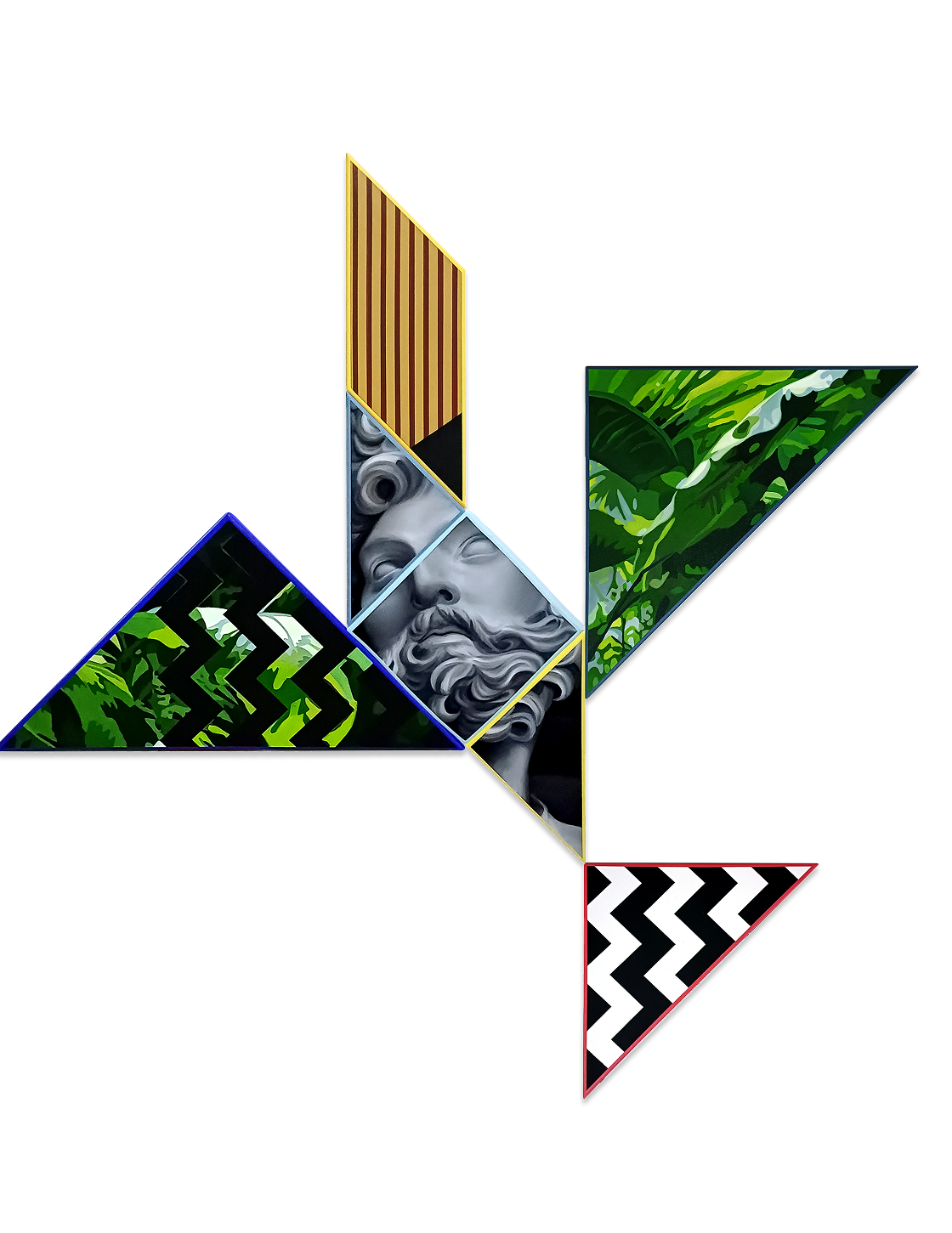
1
Vuelo
Flight
2026
Oil and acrylic on canvas
195 × 200 cm (polyptych)
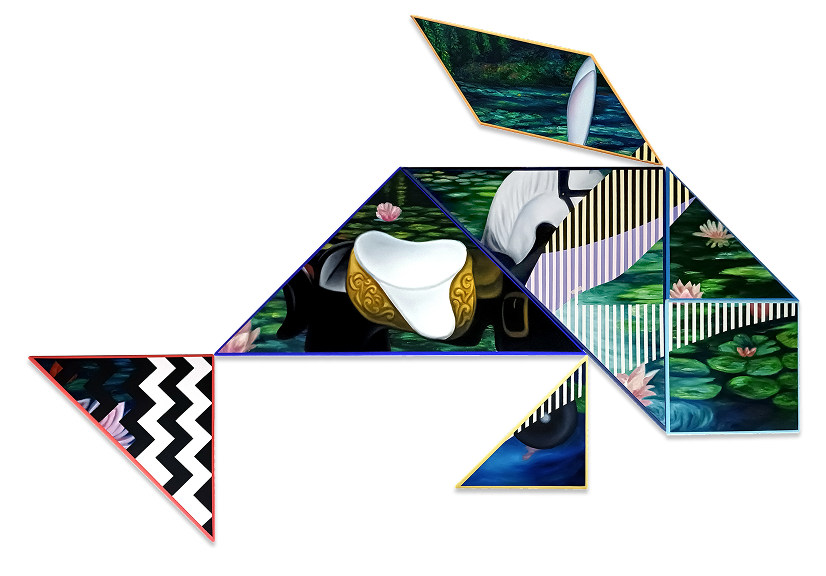
2
Caballito de Lagos
Little Horse of Lagos
2026
Oil and acrylic on canvas
145.5 × 208 cm (polyptych)
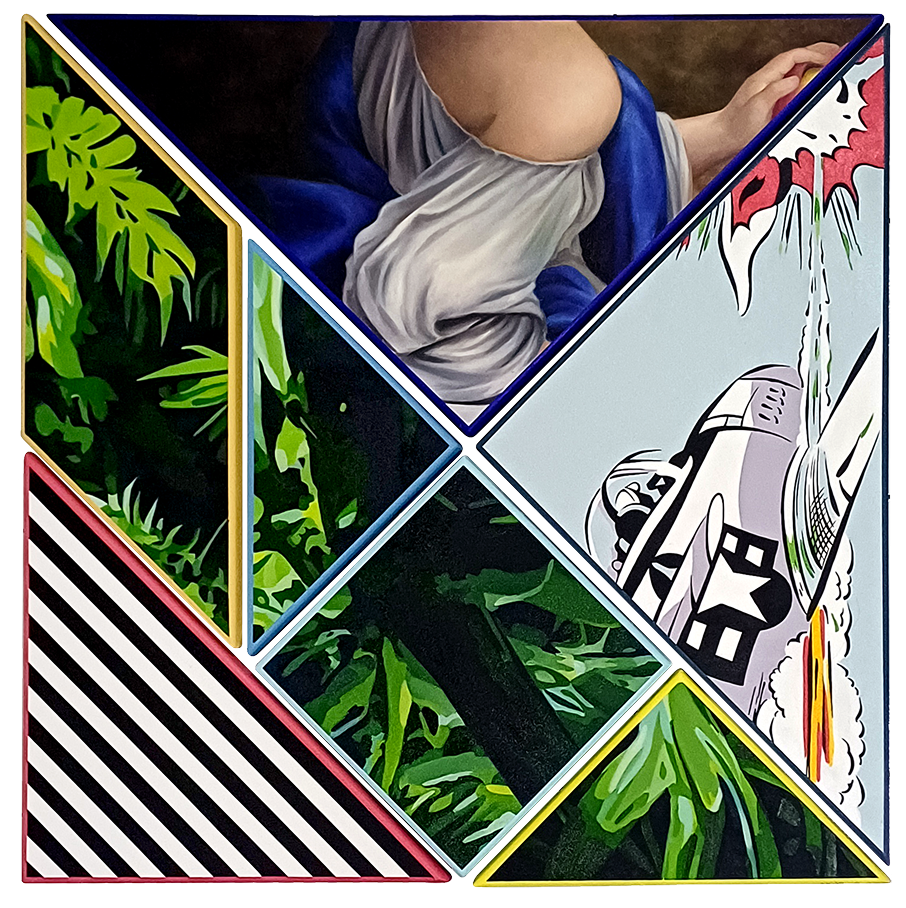
3
Cuadrado
Square
2026
Oil and acrylic on canvas
100 × 100 cm (polyptych)
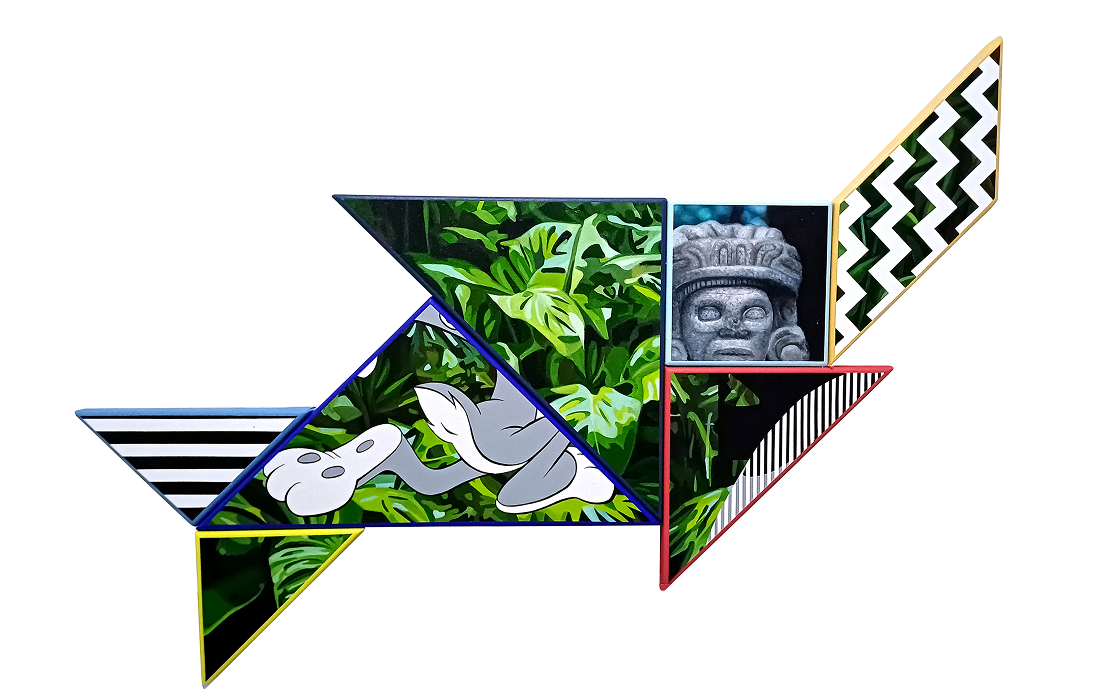
4
Pez espada
Swordfish
2026
Oil and acrylic on canvas
105 × 150 cm (polyptych)
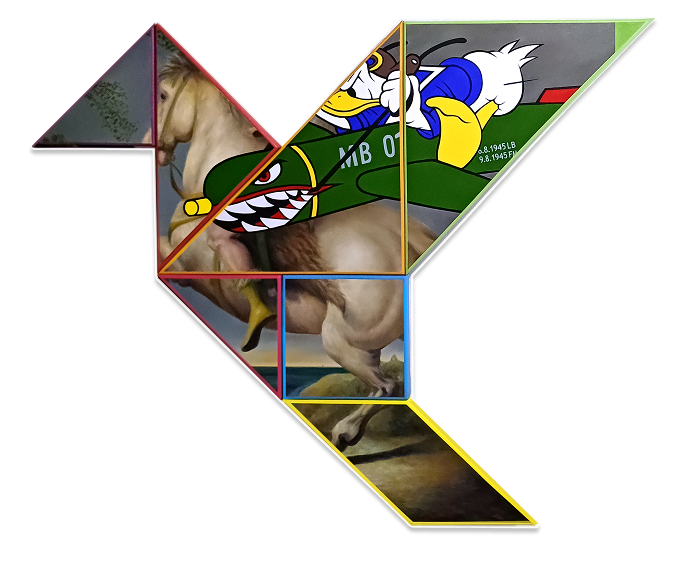
5
Ave de guerra
War Bird
2026
Oil and acrylic on canvas
134 × 164 cm (polyptych)
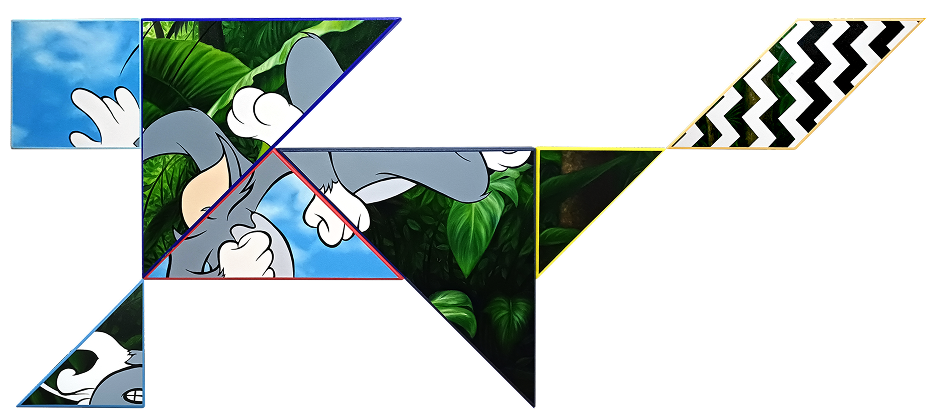
6
Felino
Feline
2026
Oil and acrylic on canvas
105.6 × 248 cm (polyptych)
II
Silences at the Margins of the Narrative
Dear reader, you have chosen to start here. Or perhaps you reached these works from the opposite end of the page. In either case, pause for a moment to consider: what happens when you attempt to fit the pieces together to find the "correct image"?
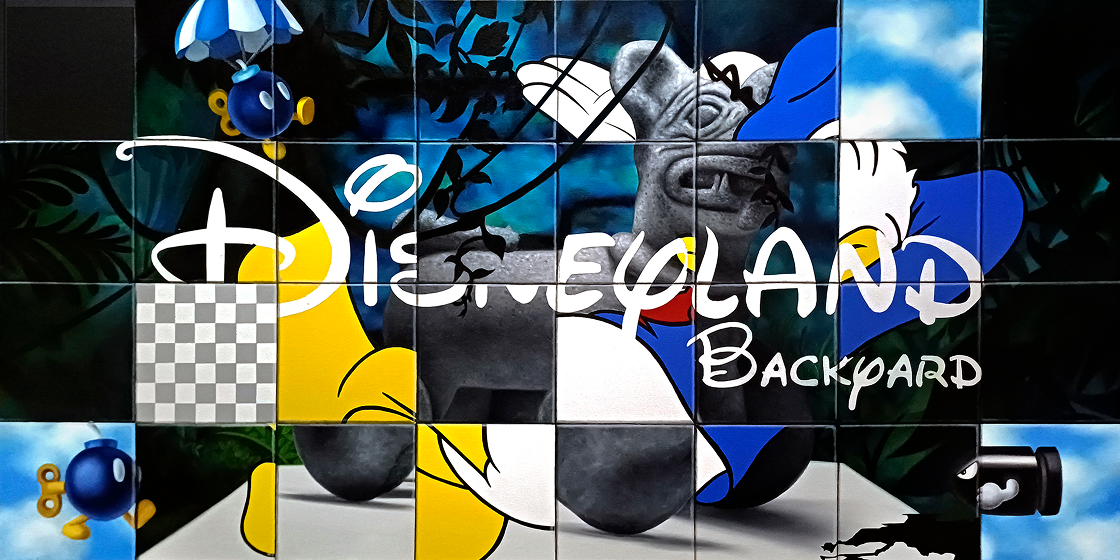
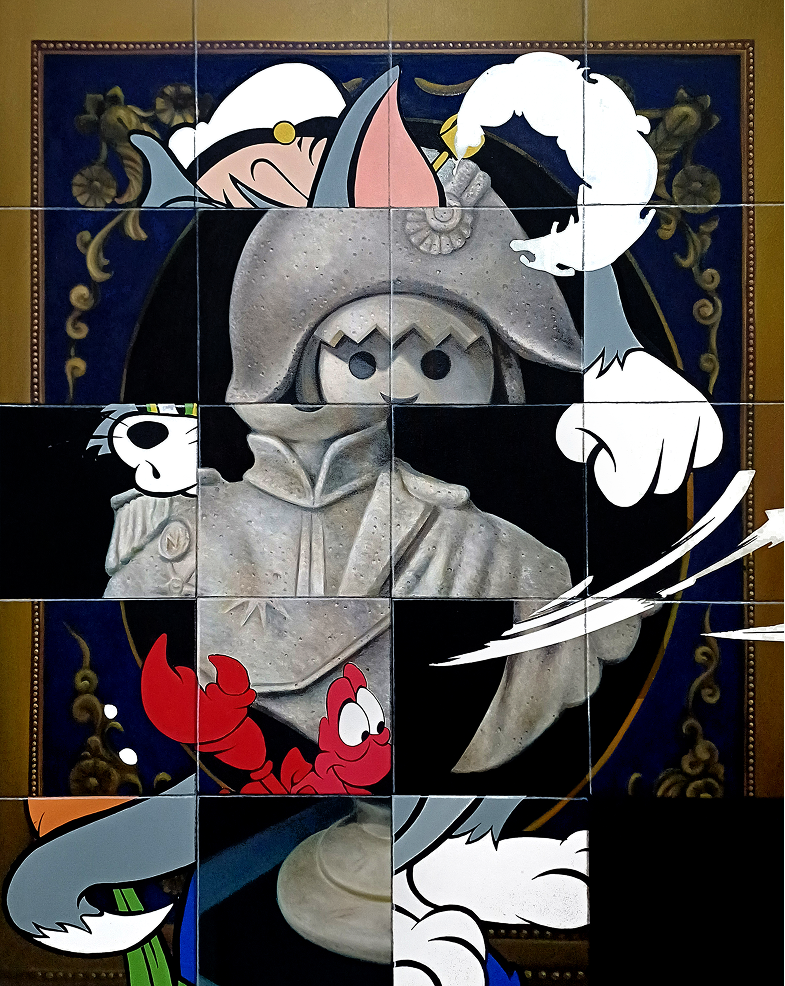
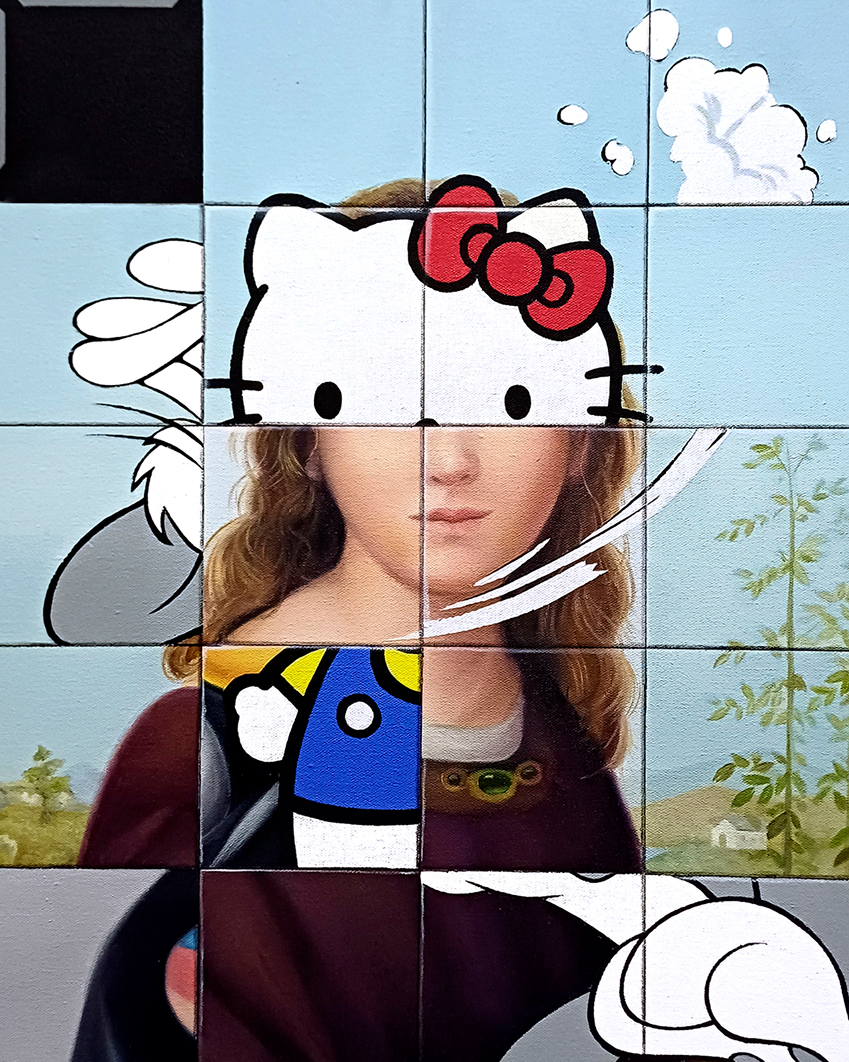
In each of these works, the artist invokes the logic of a sliding tile puzzle composed of disparate fragments, eras, and narratives. Observe them closely. You will likely identify various characters, situations, and references that your mind tries to synthesize under a certain logic. As is customary in Villatoro’s work, the image appears suspended halfway between something recognizable and something yet to be reconstructed.
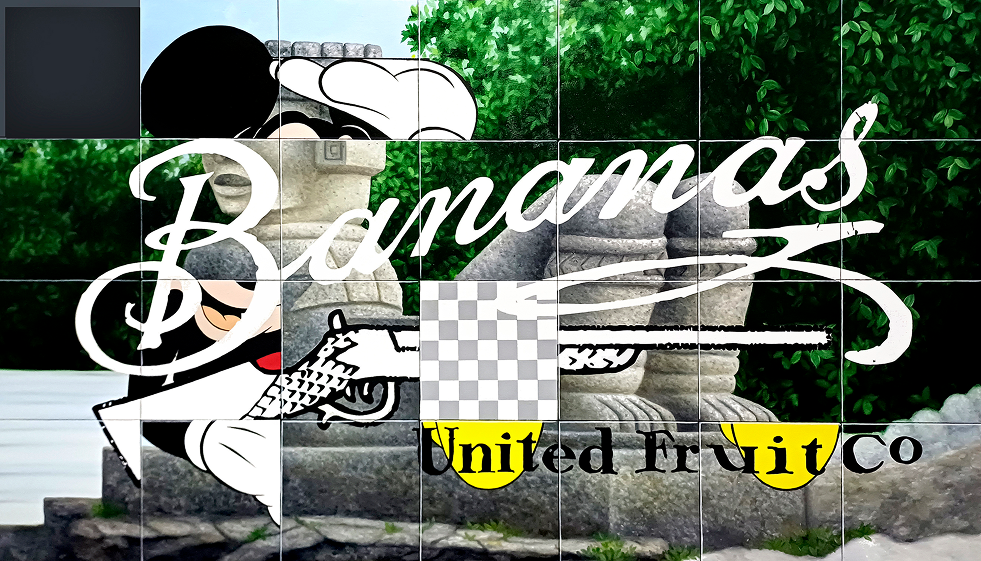
In Bananas de chac mool, for example, the painting unifies elements from Pre-Hispanic iconography with the corporate branding of a company tied to the region’s economic and political history: the United Fruit Company. Yet this puzzle also features the apparent innocence of a Disney character alongside the silhouette of a firearm—imparting an undeniable layer of critical meaning. The Chac Mool ceases to be merely an archaeological reference, and the banana is no longer just a fruit. By sharing the same plane, both begin to articulate a different story—one of appropriation, commerce, territory, and representation.
In works like this, what remains unsaid weighs more heavily than what is told. Confronted with Villatoro’s work, it is worth asking not only what we are viewing, but what has been left out of the representation.
Such is the case in Neo cabeza de jaguar, where a format traditionally reserved for portraiture mixes iconic Disney characters, a Pre-Columbian jaguar head, and Donald Duck in his rendition of Uncle Sam (I Want You) on equal footing. Here, the puzzle transcends being a mere game of ingenuity to become a framework for thinking through memory.
In attempting to reconstruct the past, we invariably work from an absence—from that empty square that allows us to slide the pieces around, while constantly reminding us that something is missing. History is indeed constructed from fragments: preserved documents, recorded testimonies, and surviving images. But it is equally written through silences—through everything that has vanished or was never recorded. What we call history is, therefore, a partial reconstruction that never encompasses the entirety of what transpired.
Dear reader, look back at these works. Observe the figures you recognize. Play for a moment, and reflect on the narratives that emerge from the connections between these references—as well as those that inhabit their silences, which we often do not know where to place.
If you started with this passage, scroll on—another question awaits you.
If you already have all the answers, keep scrolling.
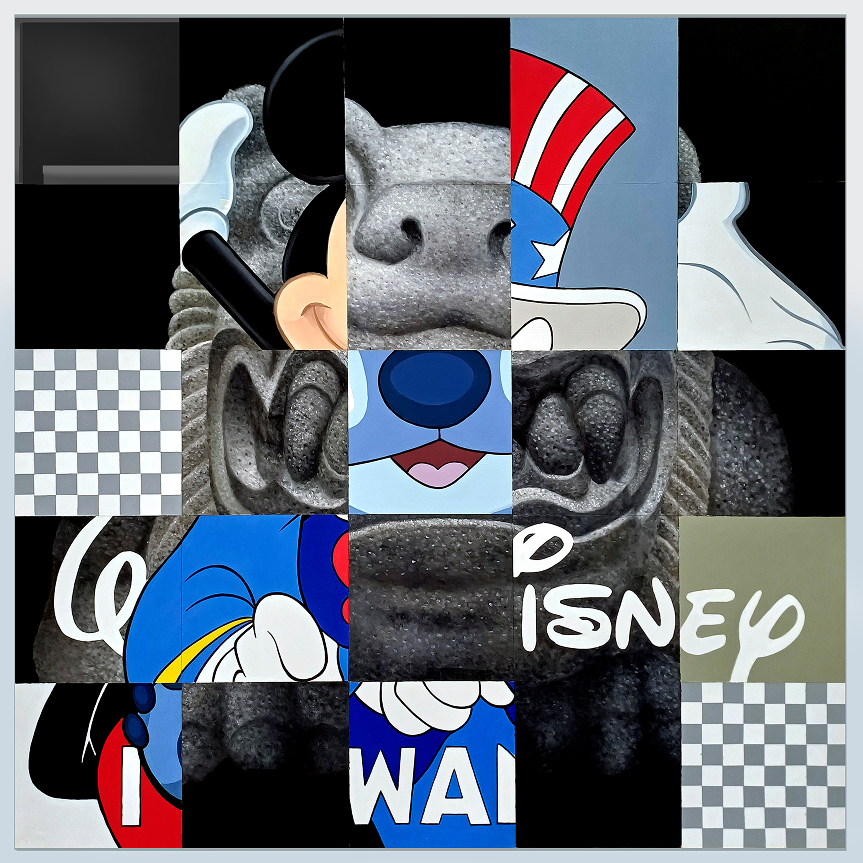
7
Neo cabeza de jaguar
Neo Jaguar Head
2026
Oil and acrylic on PLA
106 × 106 cm
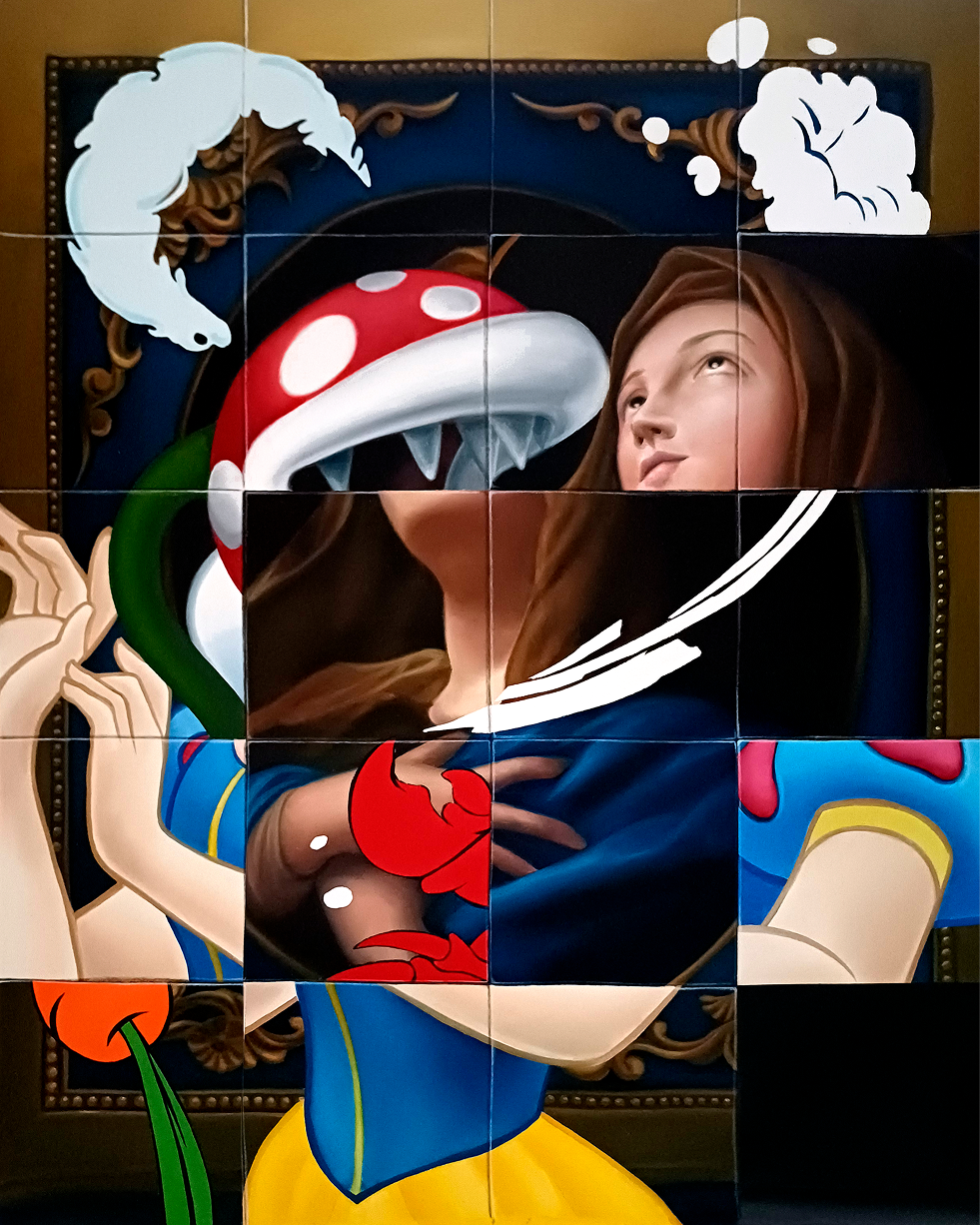
8
Neo Blanca Nieves
Neo Snow White
2026
Oil and acrylic on canvas
100 × 80 cm
9
The Backyard Dog (Xoloitzcuintle)
2026
Oil and acrylic on canvas
100 × 200 cm
10
Bananas de chac mool
Chac Mool Bananas
2026
Oil and acrylic on canvas
100 × 175 cm
11
El gobernante
The Ruler
2026
Oil and acrylic on canvas
135 × 108 cm
12
Isabel
2026
Oil and acrylic on canvas
62.5 × 50 cm

13
Alicia con el jaguar de Rastrojón
Alice with the Jaguar of Rastrojón
2026
Bas-relief in 3D-printed polymer
86 × 86 cm
III
The Inevitable Trace of Memory
Dear reader, regardless of where you began, both paths converge here.
A serpent emerges from the deepest corner of the gallery, almost concealed. Though it may have slithered through the entire exhibition to reach this point—surrounding you and expanding with every movement—you have no choice but to follow it, to attempt to make sense of it. You are not standing before a static image, but a sequence in which each fragment appears to continue the previous one while simultaneously altering it.
Beneath the tiles, a second skin emerges, drawn as a visual guide and an unmistakable reference to Quetzalcoatl. Yet it also calls to mind Snake, the game an entire generation associates with Nokia phones. In the version Taneli Armanto designed for the Nokia 6110 in 1997, the rule was elemental: advance, eat, and grow. Each new segment was incorporated into the last, forming a line that would eventually collide with itself.
With this piece, Villatoro introduces an alternative conception of time: one in which the past does not simply remain behind us, but leaves a trace that inevitably resurfaces, transformed, in the present. The serpent here does not merely embody forward motion; it represents return, transformation, and continuity.
Yet perhaps its trajectory holds the greatest significance. Dear reader, thus far you have observed fragments, established relationships between disparate images, and attempted to reconstruct what seemed hidden behind them. Now, that meaning emanates from the space itself. The history that seemed to advance from one piece to the next abandons the flat plane, climbing the walls, looping back on itself, and passing directly overhead. What appeared to be a linear path becomes a circuit that returns you to your starting point.
The serpent can be read as the sequence of disparate fragments that constitute history—a trajectory we imagine as linear and predetermined, yet can only reconstruct through the traces left behind. A paradox emerges in the process: in following the trail of history, we are also actively tracing it, as each incorporated piece, each absence, and each established connection transforms the overarching narrative, steering it in a new direction that perhaps existed all along.
Dear reader, the game continues.
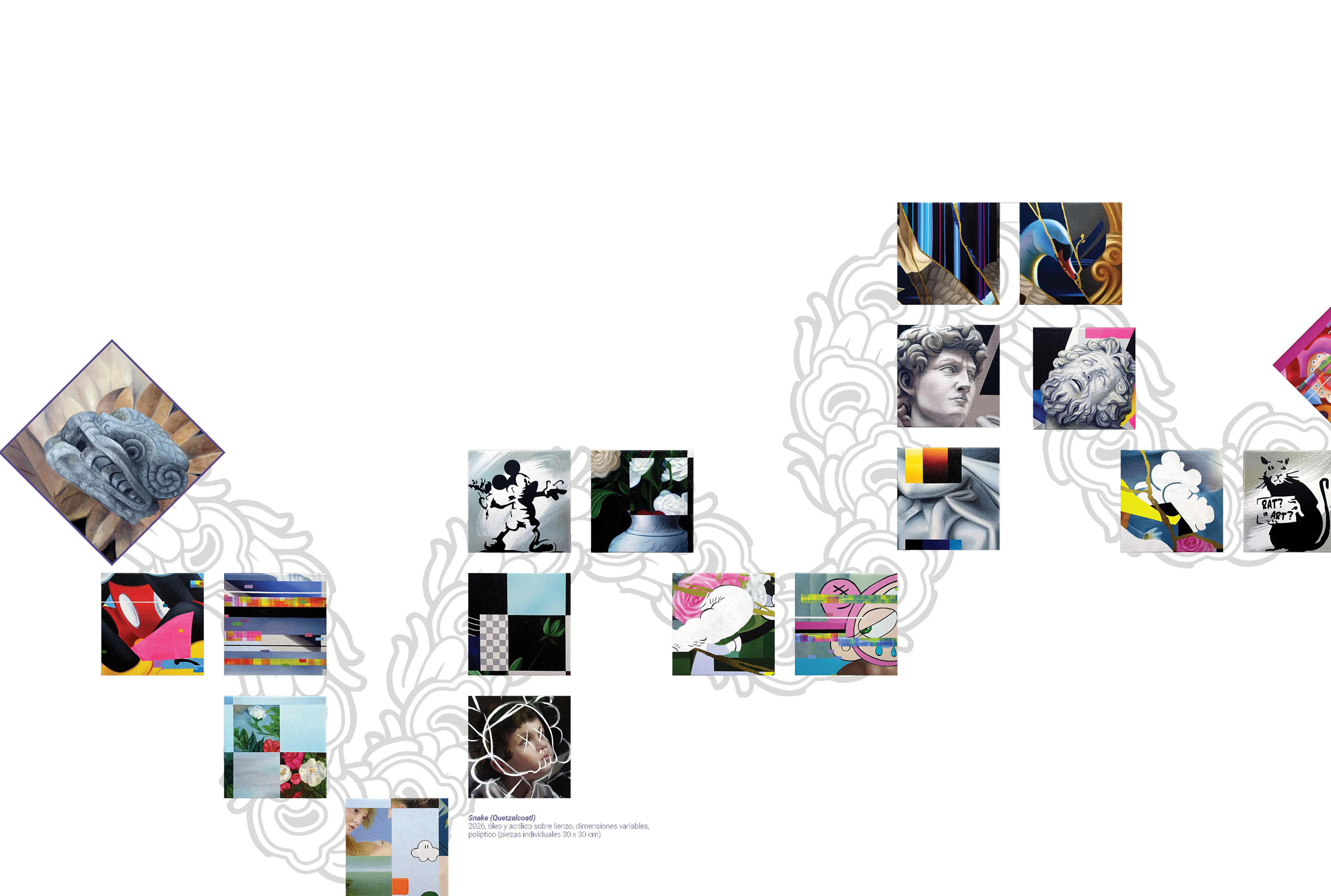
14
Snake (Quetzalcoatl)
2026
Oil and acrylic on canvas
Dimensions variable; polyptych of 30 × 30 cm panels
IV
The Rules of an Infinite Game
Dear reader, look once more at the animal figures; pause before Vuelo. Return to Bananas de chac mool, to El gobernante. Then, look for the serpent. Perhaps now you can recognize gestures shared across all of them: that a figure can contain other images; that a single reference can shift contexts; that a story emerges not only from what it reveals, but from what it omits. If one thing can be said of history, it is that over the centuries, the rules of the game have changed very little.
That is perhaps the core argument of Game On: to recognize—and simultaneously distrust—that which we take for granted. The exhibition does not query whether the past occurred, but rather the naturalness of the frameworks through which we make it legible, the mechanisms by which we assemble and order the images passed down to us, and the legitimacy of a narrative that promises to be absolute yet remains inevitably partial.
Dear reader: as the match draws to a close, if one thing becomes clear in this game we call history, with its endless rules and potential moves, it is that once we become conscious of its existence, we can no longer stop playing.
End of Game
LMD & ROM
Curators


